They were trying to locate 122 objects captured in French satellite images on 23 March that senior Malaysian officials described as the most credible lead yet as to the jetliner's whereabouts.
Later on Thursday, Thailand said it had satellite images showing 300 floating objects floating in roughly the same area. The objects, ranging in length from two to 15 metres, were found about 125 miles from the site where the French satellite had earlier spotted more than 100 pieces of debris.
Anond Snidvongs, executive director of Thailand's space technology development agency, said the information had been passed on to Malaysia. "But we cannot – dare not – confirm they are debris from the plane," he told AFP.
Officials from the Australian Maritime Safety Authority said Thursday's search had been split into two areas totalling 78,000 sq km (30,000 square miles). The operation involves planes and ships from the US, China, Japan, South Korea, Australia and New Zealand.
Locating and retrieving at least some of the floating objects could prove crucial in the absence of any physical evidence supporting the theory that MH370 ran out of fuel hours after it turned sharply off course and disappeared from air traffic controllers' screens over the South China Sea en route from Kuala Lumpur to Beijing.
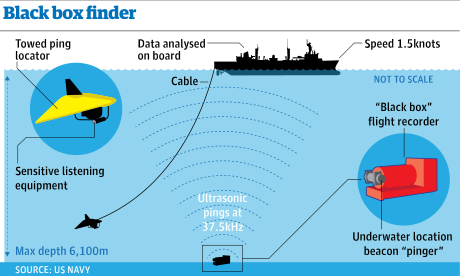
Search teams are hoping that the detection equipment will be able to pick up acoustic pings emitted every second from the plane's black box flight data recorder and cockpit voice recorder.
Each of the two recorders has a beacon, attached to the outside of the black box, which once activated by contact with water makes a sound every second.
But it is a race against time: the beacons have a battery life of 30 days, after which the pings begin to fade. Chuck Schofield of Dukane Seacom, a company that has sold the pingers to Malaysia Airlines, told Associated Press that the batteries might last an additional five days before dying.
Assuming that the plane crashed on 8 March, as Malaysian officials insist, that means the beacons aboard MH370 will begin to fade around 7 April and could go silent around 12 April.
The US navy tracking equipment – a special listening device known as a "towed pinger locator" and an underwater drone dubbed Bluefin-21 – has arrived in Perth, where the international effort is based and is being sent to the search site.
Reports said the equipment would be loaded on to the Australian navy's HMAS Ocean Shield, which will drag the locator through the water in the hope of picking up a signal.
The drone can dive to depths of about 4,500 metres, using sonar to form images of the ocean floor. Similar technology was used to locate the main wreckage from Air France flight 447 in 2011 – yet it still took searchers two years to recover the black box from the depths of the Atlantic.
The operation has been hampered by bad weather and conditions, prolonging the anguish of relatives after Malaysian officials said they had concluded that the aircraft had crashed into the sea with the loss of all on board.
Experts said search crews faced significant dangers due to frequent bad weather and the area's distance from land. "This is a really rough piece of ocean, which is going to be a terrific issue," Kerry Sieh, director of the Earth Observatory of Singapore, told Associated Press. "I worry that people carrying out the rescue mission are going to get into trouble."
Criticism of the Malaysian authorities' handling of the incident has continued, with relatives of the 154 Chinese passengers on board MH370 ridiculing Malaysian government and airline officials at a meeting in Beijing on Wednesday.
On Thursday, Malaysia Airlines ran a full-page message of condolence in the New Straits Times. "Our sincerest condolences go out to the loved ones of the 239 passengers, friends and colleagues. Words alone cannot express our enormous sorrow and pain," it said.
Chinese insurance companies have started paying compensation to the families of passengers, according to Xinhua.
Several Chinese celebrities took to social media to voice anger at the Malaysian government. In a widely shared post on Sina Weibo, China's version of Twitter, the singer and actor Chen Kun said he would boycott Malaysian goods, while the Hong Kong-born actor Deric Wan called for evidence that the plane had crashed.
"What Chinese people wanted was the truth of the missing plane instead of a pointless press conference," he said on Weibo, according to China Daily.
But in an opinion piece in Thursday's Global Times, Wang Wenwen said that while Malaysia had handled the crash aftermath ineptly, raw emotion should not be allowed to determine relations between the Chinese and Malaysian governments. "It is too early to let public opinion lead the way at the current stage. Whether Beijing-Kuala Lumpur relations will dim depends to some extent on how the [Chinese] government will act between diplomatic manoeuvering and public opinion."
The New Zealand family of Paul Weeks, one of the passengers, added their voice to criticism of the Malaysian authorities. "The whole situation has been handled appallingly, incredibly insensitively," Sara Weeks, the missing man's sister, told Radio Live in New Zealand.
"Everyone is angry about it. "The Malaysian government, the airline – it's just all been incredibly poor. Who's to say they couldn't have located the plane the day that it happened?"


0 comments:
Post a Comment